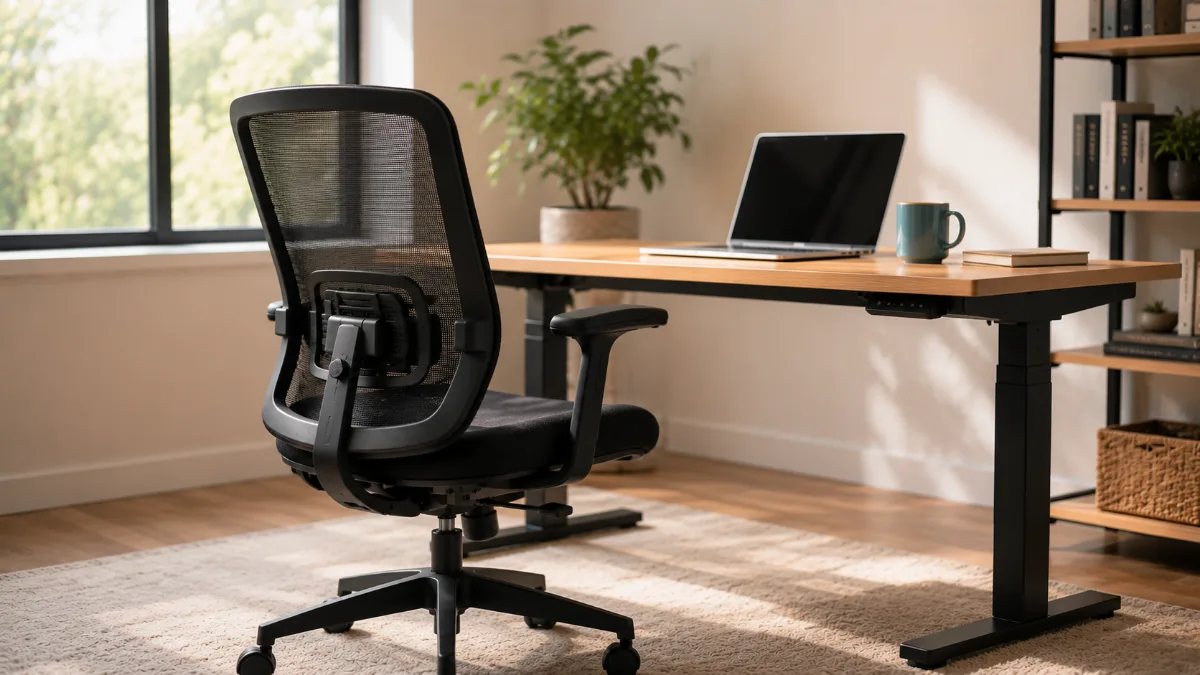
This Hbada E3 Air review is built from the pattern across hundreds of owner reports rather than a single sitting. The chair shows up constantly in budget shortlists, so the question worth answering is not whether it is comfortable on day one — it is what owners say about it at month six.
⚡ Hbada E3 Air — should you buy it?
| ✅ Buy it if | You want 3-zone lumbar + 3D headrest at this tier — rare at this price |
| ⚠️ Skip if | You weigh 220lb+ — look at the E3 Ultra for better frame support |
| 💰 Current price | Check current price on Amazon (check for coupons) |
If you’ve been hunting for an hbada ergonomic chair review that skips the marketing fluff, you’re in the right place. The Hbada ergonomic chair keeps showing up on budget shortlists, and after digging through hundreds of owner reviews, I can tell you it earns that spot — mostly. For context on how it fits into the wider budget chair landscape, check out our home office gear roundups for more honest takes on affordable remote work kit.
There’s a long list of chairs in this price bracket that look fine in product photos and fall apart — physically or ergonomically — within three months. The Hbada ergonomic chair gets thrown into that pile a lot, usually by people who haven’t sat in it. After going through a few hundred owner reviews, I’d push back on that reputation a little.
This isn’t a perfect chair. There’s one recurring durability issue that shows up reliably after about a year, and I’ll be upfront about it. But for someone setting up a home office on a tight budget, the Hbada holds up better than most of its competition at this price point — and better than some chairs that cost significantly more.
Here’s everything I found, organized so you can decide in five minutes whether this chair is right for you.
Hbada Ergonomic Chair
A genuinely solid budget chair with flip-up arms, adjustable lumbar, and a mesh back that breathes well. The main caveat: the seat cushion loses its density after about a year of heavy use, according to a consistent pattern in owner reviews. Buy it knowing that and it’s a great value. Buy it expecting a forever chair and you might be disappointed.
Hbada Ergonomic Chair
The budget chair that genuinely surprises owners — mesh back that breathes, adjustable armrests, and a build that holds up longer than the price tag suggests. The QC complaints are real but less common than they used to be.
What Owners Notice First
The flip-up arms are the thing people mention most in initial impressions — and not in a throwaway way. A lot of reviewers specifically bought the Hbada because the arms flip up, which lets them slide the chair under a desk completely, or just get them out of the way during non-desk tasks. That’s a genuinely useful feature that chairs at twice the price sometimes skip.
The second thing owners call out immediately is how breathable the mesh back feels compared to the padded-back chairs they were replacing. A lot of reviews come from people who previously had foam-back budget chairs and found them sweaty by mid-afternoon. The Hbada’s mesh back draws consistent praise for ventilation, especially from people working in warmer rooms.
Assembly comes up a lot too, but mostly in a positive way — reviews cluster around 20 to 30 minutes for solo assembly, with a few outliers going longer due to unclear diagram steps.
Lumbar Support: Better Than Expected, Not Perfect
The adjustable lumbar is one of the Hbada’s strongest selling points, and owner reviews back that up — to a point. You can move the lumbar pad up and down to hit your lower back where you actually need it, which is something a lot of chairs in this tier don’t offer at all. Shorter owners and people under about 5’6″ report the best fit, with the lumbar landing exactly where it should.
Taller owners — roughly 6’1″ and above — mention more frequently that the lumbar sits too low regardless of adjustment. It’s not a dealbreaker for everyone in that height range, but it shows up consistently enough to flag. If you’re tall and lumbar support is your top priority, this is worth knowing before you buy.
The lumbar pad itself is firm, which divides opinions. Some people find firm lumbar support helpful, others find it intrusive. I couldn’t find many reviews calling it “just right” — it tends to land on one side of that fence or the other depending on the person.
Seat Comfort and the One-Year Issue
This is the part of the review that matters most for long-term value, so I’m not going to bury it. The seat cushion thinning out after 10 to 14 months of regular use is the most consistent complaint in the entire negative review pool. It’s not a fringe complaint — it comes up in enough reviews that I’d treat it as an expected outcome rather than a defect.
For people working from home full-time, sitting in this chair six to eight hours a day, the seat foam compresses and loses density noticeably. Reviews describe it as going from comfortable to “sitting on a thin pad over a hard base.” For part-time use — a few hours a day, or a secondary chair in a shared space — this happens much more slowly, and some owners report no issue at all after 18 months.
That context matters. If you’re a full-time remote worker treating this as your primary chair, factor in the likelihood of replacing it or adding a seat cushion after year one. If you need a desk chair that will last longer without that concern, the HON Ignition 2.0 is worth comparing — it’s pricier but the seat density complaints are far less common.
The Flip-Up Arms: A Bigger Deal Than You’d Think
I keep coming back to the arms because they show up in reviews in a way that goes beyond “nice feature.” People who sit at desks with fixed-height keyboard trays, people who need to roll the chair under a standing desk while it’s in standing mode, people who share an office and need to push the chair flat against a wall — they all call out the flip-up arms specifically as the reason they chose this chair over something else.
The arms themselves are fixed-width, so you can’t adjust them inward or outward. For some people that’s a problem — if your shoulders are very wide or very narrow, fixed-width arms might sit awkwardly. But the flip-up mechanism is reported as solid and smooth by the large majority of reviewers. I couldn’t find a consistent pattern of the arm hinges failing or getting loose, which is a common failure point on cheaper chairs.
Hbada Ergonomic Chair
Compact footprint, flip-up arms, blends into a bedroom office
→
Build Quality and How It Holds Up
Outside of the seat cushion issue, the structural build of the Hbada gets decent marks. The base and gas cylinder don’t generate many complaints — sink-over-time (where the chair slowly loses height) shows up in some reviews but isn’t the dominant complaint pattern. The mesh back maintains its shape reasonably well based on longer-term owner reports.
The plastic components — armrest caps, adjustment levers, the lumbar support housing — feel like what they are: budget-tier plastic. They function fine but don’t have the solid feel of chairs at higher price points. That’s not a criticism, just a calibration of expectations.
Build quality perception in reviews tends to correlate with what people were replacing. Coming from a lower-quality basic chair, owners consistently rate it well. Coming from a mid-range office chair, expectations occasionally don’t match reality.
- Flip-up arms are practical and reportedly durable
- Mesh back is noticeably breathable, especially in warm rooms
- Adjustable lumbar hits the right spot for most people under 6’1″
- Assembly is reported as quick and manageable solo
- A lot of ergonomic features for this price tier
- Seat cushion loses density after 10–14 months of full-time use
- Lumbar may sit too low for owners over 6’1″
- Arms are fixed-width, no lateral adjustment
- Plastic components feel budget-tier in hand
See current availability
Colour options and stock change often
→
Who Should Buy the Hbada Chair
Buy it if: You work from home part-time (four hours or fewer per day), you need flip-up arms for a specific desk setup, you’re furnishing a home office on a tight budget and plan to upgrade in a year or two, or you need a second chair for a guest/spare workspace.
Skip it if: You’re a full-time remote worker logging six-plus hours a day and want a chair that stays comfortable for two or three years without intervention. Also skip it if you’re over 6’1″ and lumbar support is non-negotiable — the adjustment range just doesn’t have enough travel for taller frames.
If the seat longevity issue is a dealbreaker and you want to stay in a similar price range, the HON Ignition 2.0 is the most commonly recommended alternative in the same tier. It costs more but the seat density complaints are far less frequent in long-term reviews. And if you’re thinking about pairing a new chair with a standing desk upgrade, our look at the FlexiSpot E7 standing desk covers one of the best options in that space.
Hbada Ergonomic Chair
For a budget chair, the Hbada gets a lot right. The flip-up arms are genuinely useful, the mesh back breathes well, and the adjustable lumbar is a feature most chairs at this price don’t even attempt. The seat cushion durability is a real concern for full-time remote workers, but with realistic expectations it’s one of the better options at this price point. If you need a capable chair right now without spending a lot, this delivers on that ask.
Quick Takeaways
- The flip-up arms are the standout feature — practical, durable, and a genuine reason to pick this over alternatives.
- Mesh back breathability is consistently praised, especially by people replacing foam-back budget chairs.
- Adjustable lumbar works well for most people under 6’1″; taller owners run into adjustment limits.
- Seat cushion compression after 10 to 14 months of full-time use is the most consistent long-term complaint — plan accordingly.
- Assembly averages 20 to 30 minutes solo based on owner reports, which is on the easier end for this category.
- Best suited for part-time use, budget home office setups, or secondary workstations rather than all-day primary seating.
So that’s the full hbada ergonomic chair review. The short version: it’s a legitimately decent hbada ergonomic chair for the price, especially if you’re in your first year of home office life and not ready to spend serious money on seating. If your setup needs a desk upgrade too, our FlexiSpot E7 review covers the standing desk that pairs well with a budget chair like this one.
Frequently Asked Questions
Is the Hbada E3 Air good for back pain?
The Hbada E3 Air has a breathable mesh back and adjustable lumbar support, making it a decent budget option for mild back discomfort. The lumbar adjustment is limited compared to premium chairs. For diagnosed lower back conditions, a chair with independent height and depth lumbar adjustment (like the HON Ignition 2.0 or Herman Miller Aeron) provides more targeted support.
How does Hbada compare to mid-range ergonomic chairs?
Hbada chairs sit in the mid-range bracketprice range and compete with brands like Sihoo, SMUG, and Office Star. They offer more adjustability than basic office chairs but less build quality than commercial-grade options. Plastic components feel lighter than expected; the mesh quality is adequate for 4–6 hour sessions. For 8+ hours of daily use, consider spending that much for better durability.
Does the Hbada E3 Air come assembled?
Partial assembly required — typically 15–25 minutes. The chair ships with the back already attached to the seat mechanism. You install the gas cylinder, base, and armrests. All tools are included. Instructions are straightforward; most users complete assembly without referencing the manual more than once.
What is the weight limit for the Hbada E3 Air?
The Hbada E3 Air has a weight capacity of approximately 250lbs (113kg). The seat is designed for users up to approximately 6’1″ in the standard version. If you are above this weight or height, look at Hbada’s heavy-duty variants or consider chairs specifically rated for larger users.
📚 Related Articles
Hbada Ergonomic Chair is the pick most readers here land on. Stock and deals shift often, so it is worth checking what it is going for right now.