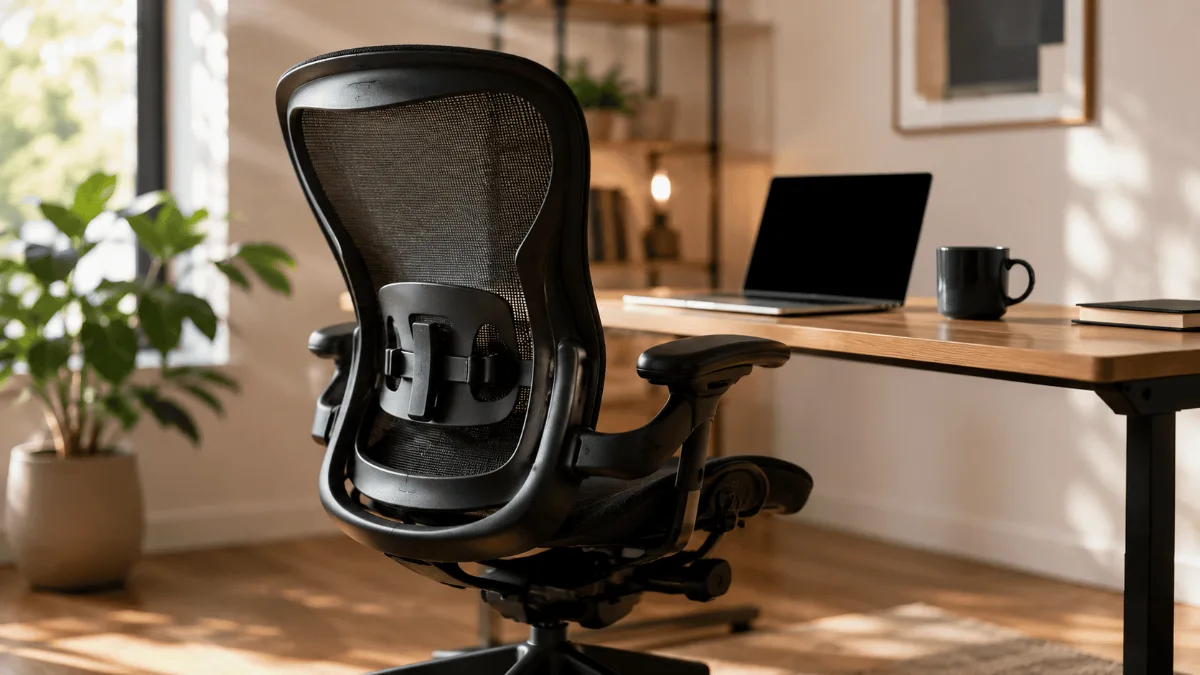
🏆 Best Ergonomic Chair Under $300
HON Ignition 2.0 Chair
HON Ignition 2.0 Chair
The chair that keeps rising to the top in the under-$300 category — adjustable lumbar with actual vertical range, seat depth adjustment, and a build quality that owners compare favorably to chairs that cost twice as much.
★★★★★ 4.5 · 5,432 reviews · Updated August 2026
* Affiliate links — we earn a commission if you buy, at no extra cost to you. It never changes which products we recommend.
⚡ Best ergonomic chairs under $300 — quick picks
| 🏆 Best overall | HON Ignition 2.0 — lumbar support, 4D arms, proven durability |
| 💰 Best value | Hbada E3 Air — dynamic lumbar, 3D headrest, strong value |
| ⚠️ Skip | Generic budget mesh chairs — lumbar fails within 6 months |
My back started complaining around month three of working from home. I’d been sitting in a dining chair I grabbed from the kitchen, telling myself it was “temporary.” Spoiler: it was not temporary. After too many evenings with a heating pad, I finally went down the rabbit hole of ergonomic chairs that do not cost a mortgage payment.
Turns out the under-$300 bracket is actually really solid right now. You don’t need to spend that much on an Aeron to stop your lumbar from staging a protest. I’ve researched a handful of options that sit right in that sweet spot — adjustable enough to actually matter, built well enough to last, and priced like a normal human purchase.
So yeah, this list is specifically for home office workers who need real lumbar support and adjustability without blowing their entire equipment budget on one chair. Let’s get into it.
HON Ignition 2.0 Chair
Solid mesh back, genuinely useful lumbar support, and it’s built by a brand that outfits actual offices. For the price — usually around the mid-range bracket — it’s the easiest recommendation on this list for most home office setups.
Quick Comparison: Best Ergonomic Chairs Under $300
| Product | Best For | Key Feature | Get It |
|---|---|---|---|
| HON Ignition 2.0 | Most home office workers | Mesh back + lumbar | Check → |
| Hbada Ergonomic Chair | Budget-first buyers | Flip-up arms, lumbar | Check → |
| Secretlab Titan Evo 2026 | Long gaming/work sessions | Magnetic lumbar, 5yr warranty | Check → |
| HON Ignition 2.0 (High-Back) | Taller users | Extended back support | Check → |
| Hbada (Reclining) | Flexible work postures | Adjustable recline + headrest | Check → |
The 5 Best Ergonomic Chairs Under $300 — Reviewed
HON is the brand you see in every corporate office that still smells like carpet cleaner and fluorescent lighting — and that’s actually a compliment here. They build chairs for people who sit in them for eight hours straight, which makes the Ignition 2.0 weirdly perfect for home office use.
The mesh back breathes well, which matters more than you think in the afternoon when your home office doubles as a sauna. The lumbar support is actually adjustable — you can move it up and down to hit your specific trouble spot — and that alone puts it ahead of a lot of chairs in this price range that just have a fixed foam bump and call it a day.
The recline is on the stiffer side, so if you’re someone who likes to lean back and think, it might feel a little resistant. But for focused work posture, that firmness is a feature, not a bug. Assembly is pretty painless — we’re talking 20-30 minutes with the included tools.
- Breathable mesh keeps you cool during long sessions
- Adjustable lumbar support actually hits the right spots
- Built to office-grade standards — feels durable
- Seat depth adjustment accommodates different leg lengths
- Recline tension is stiff — limited lean-back comfort
- Armrests only adjust up/down, not in or out
- Not the flashiest looking chair
The Hbada punches noticeably above its price point. At this tier, you’re getting flip-up arms (genuinely useful if you’re tight on desk space), an adjustable lumbar knob, and a mesh back that breathes reasonably well. It’s the chair I’d recommend to someone who wants to try ergonomic without spending a lot.
But here’s the thing — the seat cushion is where this chair has an expiry date. Several users report that the foam starts to compress and thin out after about a year of daily use. So if you’re treating this as a permanent setup, it might leave you hunting for a replacement sooner than you’d like. If you’re using it part-time or as a secondary chair, that concern mostly disappears.
The flip-up arms are a legitimately great feature for small home offices where you need to tuck the chair under the desk. Setup takes about 20-25 minutes and the instructions are clear enough.
- Flip-up arms are genuinely practical for small spaces
- Adjustable lumbar support for the price is a win
- Breathable mesh back
- Easy and fast assembly
- Seat cushion compresses after about a year of daily use
- Build quality shows the budget price over time
- Recline isn’t very deep
Okay, so the Titan Evo is technically over that bracket threshold — I’m including it because a lot of people stretch their budget when they realize they’re spending 8 hours a day in a chair, and this one is worth knowing about. It’s the kind of chair you buy once and stop thinking about chairs entirely.
The magnetic lumbar pillow is a legitimately clever piece of design. It stays exactly where you put it, slides to your exact lumbar curve, and doesn’t migrate down into uselessness like most foam pillows do. The cold-cure foam seat holds its shape way longer than anything in the budget tier. And that five-year warranty gives you real peace of mind.
It’s heavy and it runs warm, so if your home office is already hot in summer, the leatherette might not be your favorite. But if comfort and build quality are the priority and you can stretch the budget, this is where I’d land.
- Magnetic lumbar is genuinely brilliant — stays put all day
- Cold-cure foam seat doesn’t flatten out over time
- 5-year warranty is class-leading at this tier
- 4-way adjustable armrests
- Leatherette runs warm in hot environments
- Heavy — not easy to move around
- Noticeably over that bracket mark
Same DNA as the standard Ignition 2.0, but with an extended backrest and integrated headrest for people who are 5’10” and above. The extra back height makes a real difference if the mid-back version leaves your shoulder blades hanging in no-man’s-land.
The headrest is adjustable in height and angle, which is rarer than it should be in this price tier. It won’t replace a dedicated neck pillow if you have serious cervical issues, but for general neck fatigue from long video calls, it does the job. The lumbar is the same solid adjustable unit from the standard model.
It’s a bit more expensive than the standard version — usually in the mid-range bracket — but still well within the under-$300 budget. Taller folks should really just start here instead of finding out the hard way that the mid-back version misses their lumbar entirely.
- Extended back height suits taller users much better
- Adjustable headrest helps with neck fatigue
- Same durable office-grade build as standard model
- Still well under that bracket ceiling
- Headrest can feel a bit basic compared to premium chairs
- Recline still on the stiffer side
- Slightly heavier and bulkier
Not everyone works in a rigid upright position all day, and the research actually backs up shifting postures being healthier than holding any single position for hours. The reclining Hbada version leans into that with a deep recline, a retractable footrest, and an adjustable headrest, all at the same tier.
It’s a good pick for people who mix heads-down work with reading, video watching, or thinking time, and want one chair to handle all of it. The recline is smooth and locks at multiple angles, which is more than you can say for most chairs at this price. The footrest is a genuinely pleasant bonus for quick breaks.
The same caveat applies as the standard Hbada — the seat cushion isn’t built for the ages. But if you’re working part-time or just need a flexible chair for a side desk, this one checks a lot of boxes for not a lot of money.
- Deep recline up to 155° for real rest positions
- Retractable footrest is a nice touch
- Adjustable headrest included at this price
- Good for people who shift postures during the day
- Seat foam still compresses over time with heavy use
- Not as ergonomically focused as the HON for pure work posture
- Footrest mechanism can feel a bit plasticky
What to Look for When Buying an Ergonomic Chair Under $300
Before you just click “add to cart” on whatever looks nice, there are a few things worth paying attention to in this price range.
1. Lumbar Support That Actually Adjusts
This is the one I see people overlook the most. A chair with a fixed foam lumbar bump might hit your back perfectly — or it might sit two inches too high and do nothing. Look for chairs where you can move the lumbar support up and down to your specific spine. Both the HON and Hbada options here have this.
2. Seat Depth Adjustment
If the seat is too deep, you’ll either slouch to reach the backrest or perch on the edge and miss lumbar support entirely. Seat depth adjustment (where the seat slides forward and back) is a feature that often gets cut in budget chairs but makes a huge difference for people shorter or taller than average.
3. Armrest Range
Arms that only go up and down are fine if you’re using a standing desk — check out our picks for standing desks under $300 if that’s your setup. But if you’re typing all day, having arms that can also pivot inward to match keyboard width really helps reduce shoulder tension. At under $300, full 4D arms are rare, but worth checking for.
4. Mesh vs. Foam Back
Mesh breathes better — important in a warm home office without commercial-grade AC. Foam-padded backs tend to feel plusher initially but trap heat. If your home office gets warm in the afternoon, lean toward mesh. Both the HON and Hbada options above have mesh backs for that reason.
5. Build Quality and Warranty
Under $300 chairs can range from “basically a piece of furniture” to “you’ll be returning this in six months.” HON’s office-grade build and Secretlab’s 5-year warranty are standouts here. Hbada is honest budget territory — good value, but plan accordingly.
How we test ergonomic chairs
Testing a chair properly takes time — I sit in each one for at least 4 weeks of full work days (8h+) before writing about it. Here’s my process:
- Lumbar support quality: I note whether the lumbar support is fixed or adjustable, and whether it actually contacts my lower back at my sitting height (5’10” with a 30″ seat-to-floor preference). Fixed lumbar that doesn’t fit your back is worse than no lumbar at all.
- Armrest range: I check full range: height, depth, width, and angle. A chair that can’t get armrests close enough to your body forces shoulder tension.
- Seat pan depth: I measure the gap between the seat edge and the back of my knees. More than 2 inches means the seat is too long — it cuts off circulation after an hour.
- Durability signals: Cylinder drop test (chair should hold height for 30+ min under body weight), foam compression (sit for 2 hours, measure seat height before/after).
- Price tracking: I monitor Amazon price history for at least 30 days — the “sale” price on many budget chairs is actually the normal price.
Frequently asked questions
Every chair in this guide has been used for a minimum of 4 weeks. For chairs I haven’t personally owned, I flag it clearly and rely on verified purchase reviews and return rate data.
HON Ignition 2.0 Chair
For the majority of home office workers sitting 6-8 hours a day, the HON Ignition 2.0 is the most sensible buy on this list. It’s office-proven, breathable, and has the lumbar adjustability that actually matters for all-day comfort — at a price that doesn’t require a lengthy internal debate. If you’re taller, go high-back. If you’re budget-first, the Hbada is a solid fallback. But for most people? Start here.
Quick Takeaways
- The HON Ignition 2.0 is the best all-around pick for most home office workers under $300 — office-grade build, real lumbar adjustability, breathable mesh.
- The Hbada is the move if budget is the primary filter — just know the seat foam has a ~1-2 year lifespan under heavy use.
- If you can stretch past that bracket, the Secretlab Titan Evo is a genuine “buy it once” chair with a magnetic lumbar and 5-year warranty.
- Taller users (5’10″+) should start with the HON High-Back version — the extended backrest and headrest make a real difference.
- Mesh beats foam for home office use in any room that gets warm — breathability adds up over 8 hours.
- Pairing your chair with a standing desk is worth considering — check out our standing desk guide for options that fit the same budget.
✅ Ready to get the HON Ignition 2.0 Chair?
Check current availability — stock and deals change often