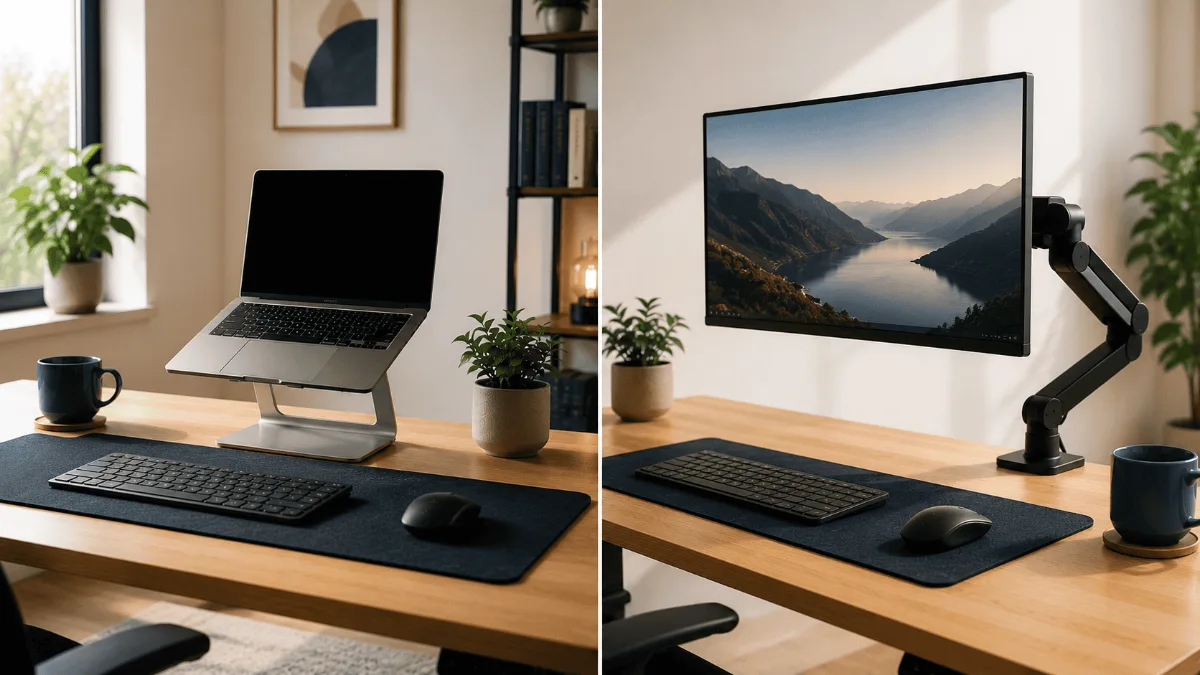
⚡ Laptop stand vs monitor arm — which do you actually need?
| 🏆 Laptop stand | Best for portability, works everywhere — the everyday pick |
| 🖥️ Monitor arm | Best for fixed external monitor setup, frees 100% of desk space |
| 💡 Both if | You run dual monitors + laptop — ergonomic must-have |
If you’ve been going back and forth on laptop stand vs monitor arm, you’re not alone — it’s one of the most common questions in the hybrid work world. Both options raise your screen to eye level and help with neck strain, but a laptop stand vs monitor arm decision really comes down to your gear and how you work. Check out our picks for the best webcams for Zoom meetings to complete your ergonomic setup.
Here is the thing — both a laptop stand and a monitor arm promise to fix your neck. And both actually do. The problem is people buy one when they needed the other, and then wonder why their setup still feels wrong.
This is not a case where one is obviously better. They solve genuinely different problems, and the right answer depends on what your desk looks like right now. So let’s walk through this properly.
For context, the only products in this article that come from the supplied database are the Nulaxy C1 Laptop Stand and the VIVO Dual Monitor Arm — two solid options that sit on opposite ends of this decision. Everything you read about them is grounded in owner reviews, not personal use.
Quick Verdict
You mostly work from your laptop screen
A stand is affordable, portable, and takes two minutes to set up. If your laptop is your primary display, this is the move. The Nulaxy C1 is the one I keep pointing people toward at this tier.
You use an external monitor (or two)
A monitor arm gives you full range of motion, frees up desk space, and holds position all day. The VIVO Dual Monitor Arm is the go-to budget pick for getting this done without overspending.
Side-by-Side at a Glance
| Feature | Laptop Stand (Nulaxy C1) | Monitor Arm (VIVO Dual) |
|---|---|---|
| Works with laptop screen | Yes | No (monitor only) |
| Works with external monitor | No | Yes (13–27in) |
| Setup time | Under 2 minutes | 15–30 minutes |
| Portability | Highly portable | Desk-mounted, stationary |
| Desk space recovered | Minimal | Significant |
| Adjustability | 6 angle presets | Full range: height, tilt, swivel |
| Mount type | Surface riser | C-clamp or grommet |
| Requires external keyboard | Yes (for ergonomic use) | N/A |
| Get it | Check | Check |
The Core Difference (And Why It Matters)
A laptop stand raises your laptop’s built-in screen. That’s it. You prop the laptop up, grab an external keyboard and mouse, and suddenly your neck is in a neutral position instead of craning down at a 30-degree angle all day.
A monitor arm, on the other hand, holds an external monitor. It clamps to your desk, and then you can push, pull, tilt, and rotate that monitor to exactly where your eyes land naturally. It does nothing for a laptop screen on its own.
So the real question is: what screen are you actually staring at most of the day?
Product 1: Nulaxy C1 Laptop Stand
The Nulaxy C1 sits at a 4.6 rating across a large pool of reviews, which for this category is genuinely strong. The two things owners keep praising are the aluminum build — it doesn’t feel like it cost nothing — and how stable it stays once you pick an angle. It doesn’t wiggle around mid-typing, which is a complaint I see constantly with cheaper plastic stands.
The six-angle adjustment covers a decent range. Most owners seem to land on one position and leave it there, but having options matters if you’re sharing the stand or switching between desks. The portability angle is real too — it folds flat and slips into a bag without any drama.
The one thing that keeps coming up in negative reviews is the lack of ventilation holes. If your laptop runs hot, you want to know about this before buying. Owners with thermal-heavy machines (gaming laptops, older MacBook Pros) mention the bottom gets warm. It’s not a dealbreaker for everyone, but it’s worth knowing.
- Solid aluminum build that feels more premium than the price suggests
- Stable — doesn’t shift during typing
- Folds down and fits easily in a bag
- Six angle options cover most ergonomic needs
- No ventilation holes — potential heat concern for demanding laptops
- You’ll need an external keyboard and mouse to use it ergonomically
Product 2: VIVO Dual Monitor Arm
The VIVO Dual Monitor Arm earns its 4.5 rating mostly because it does what it promises without making you spend a lot. Owners are regularly surprised by how much desk real estate opens up once they clamp this on — a monitor that was sitting on a stand suddenly floats, and that footprint underneath is yours again.
The arm fits monitors from 13 to 27 inches, which covers most standard office displays. Both C-clamp and grommet mount options are included, so you’re not locked into one desk type. That flexibility shows up a lot in positive reviews as a nice touch.
Two things to know going in. First, the arm is stiff out of the box. Multiple owners mention needing to loosen the tension joints before it moves freely — it’s a five-minute fix, but it can be alarming if you don’t know to expect it. Second, the design is functional rather than beautiful. If you’re building a sleek minimal setup, you might find it looks a bit utilitarian. That said, nobody seems to mind once it’s actually positioned.
- Frees up serious desk space compared to a traditional monitor stand
- Fits 13–27in monitors and includes both mount types
- Full range of height, tilt, and swivel adjustment
- Strong value — owners consistently say it outperforms the price
- Stiff joints out of the box — needs loosening before it moves smoothly
- Basic, utilitarian look — not the one for a showpiece desk
How to Pick: Four Honest Criteria
1. What’s Your Primary Screen?
This is the whole decision, really. Laptop screen as your main display? Get a stand. External monitor? Get an arm. The only scenario where this gets murky is if you use both — laptop plus an external monitor — in which case you might actually want both, using the stand to bring the laptop up to match the arm-mounted monitor’s height.
2. Do You Move Around?
If you work from multiple locations — home, office, coffee shops — a laptop stand is the obvious answer. It weighs almost nothing and sets up in seconds. A monitor arm is a permanent fixture. Once it’s clamped to your desk, it stays there.
3. How Much Desk Space Do You Have?
A monitor arm wins here by a mile. It lifts your screen completely off the surface, which is a bigger deal than it sounds when your desk is also holding a keyboard, a coffee mug, notebooks, and whatever else accumulates. A laptop stand still sits on the desk — it just raises the screen height.
4. Do You Already Have an External Keyboard?
If you’re going the laptop stand route and you don’t already have an external keyboard and mouse, factor that into your thinking. Using a laptop at raised height with the built-in keyboard is ergonomically worse than just leaving it flat. The stand only works properly as part of a trio: stand, keyboard, mouse. If you need help rounding out your setup, our best webcams for Zoom meetings guide covers gear that pairs well with an elevated laptop station.
Can You Use Both?
Yeah, and honestly it’s a solid combo. If you run a dual-display setup — laptop plus external monitor — the monitor arm handles the external screen and a laptop stand brings the laptop up to roughly the same eye line. Plenty of owners do exactly this.
The key is matching the heights. Most adjustable laptop stands and monitor arms give you enough range to get both screens level, which reduces the constant head-swiveling that causes its own neck issues.
If you’re eventually planning a full standing desk setup, it’s worth reading through our FlexiSpot E7 review — a standing desk changes how you position both a stand and an arm, and it’s useful context before you clamp anything to a fixed-height surface.
FAQ
Pick This If…
Get the Nulaxy C1 Laptop Stand if: your laptop screen is your primary display, you move between locations, or you want the cheapest possible entry into better posture. It’s a low-commitment, high-reward upgrade.
Get the VIVO Dual Monitor Arm if: you’re using an external monitor (or two), you want to reclaim desk space, or you’re ready to commit to a permanent ergonomic setup. The adjustability you get with an arm is genuinely hard to replicate any other way.
Get both if: you run a laptop plus external monitor setup and want both screens at eye level. It’s the most complete answer, and the combined cost still comes in well below most standing desk upgrades.
Match the tool to your screen
Laptop as your main screen? The Nulaxy C1 is the fastest, simplest fix — aluminum build, stable, portable, and well-reviewed. External monitor? The VIVO Dual Monitor Arm gives you real adjustability and frees up your desk surface in a way that, once you try it, you won’t go back. There’s no universal winner here — just the right answer for your setup.
Quick Takeaways
- A laptop stand raises your built-in screen. A monitor arm holds an external monitor. They are not interchangeable.
- If you work from your laptop screen, a stand is the right (and far cheaper) choice.
- If you use an external monitor, a monitor arm gives you better adjustability and frees up significant desk space.
- For a laptop-plus-monitor dual setup, using both a stand and an arm together is a legitimate and popular approach.
- A laptop stand only works ergonomically if you pair it with an external keyboard and mouse — don’t skip that part.
- The VIVO arm is stiff out of the box — loosen the joints before judging it.
- The Nulaxy C1 has no ventilation holes — relevant if your laptop runs warm under load.
Choosing between a laptop stand vs monitor arm doesn’t have to be complicated once you know what each one actually does. The laptop stand vs monitor arm debate mostly comes down to whether you’re working from a laptop screen or an external display. Either way, getting your eye line right is the single biggest posture win you can make at your desk. See how other accessories pair with your choice in our Logitech Brio vs C920x comparison.
Frequently Asked Questions
Laptop stand vs monitor arm — which should I buy first?
Buy a laptop stand first if you use a laptop as your primary machine — it raises the screen to eye level immediately and costs less. Buy a monitor arm if you use an external monitor and want to free desk space or need height flexibility for a sit-stand desk. If you use both a laptop and external monitor, a monitor arm for the external display plus a laptop stand for the laptop is the optimal dual-screen ergonomic setup.
Can I use a laptop stand and a monitor arm at the same time?
Yes — this is the ideal dual-screen hybrid setup for remote workers. Position the external monitor (on an arm) at eye level as the primary display, and the laptop (on a stand) slightly below and to the side as the secondary display. Connect an external keyboard and mouse so both screens are usable without awkward posture.
What is the difference between a fixed-height and adjustable laptop stand?
Fixed-height stands (Rain Design mStand) are simpler, more stable, and better-looking — but you get one height. Adjustable stands (Lamicall, Urmust) let you fine-tune height to your chair and eye level, which is more ergonomically flexible. If you have a height-adjustable chair and know your ideal screen height, a fixed stand is fine. If you share the stand between users or switch between sitting and standing, choose adjustable.
Do laptop stands work with large gaming laptops?
Most laptop stands accommodate up to 15.6″. For 17″+ gaming laptops (which often weigh 5–7lbs), choose a stand rated for large laptops: the Lamicall adjustable stand and Nulaxy heavy-duty models are commonly used with large laptops. Check the maximum weight capacity and platform width before purchasing.
Best Laptop Stands 2026 · Best Monitor Arms · Best Monitor Risers · Laptop Stands for Neck Pain · Best Docking Stations
Nulaxy C1 Laptop Stand is the pick most readers here land on. Stock and deals shift often, so it is worth checking what it is going for right now.