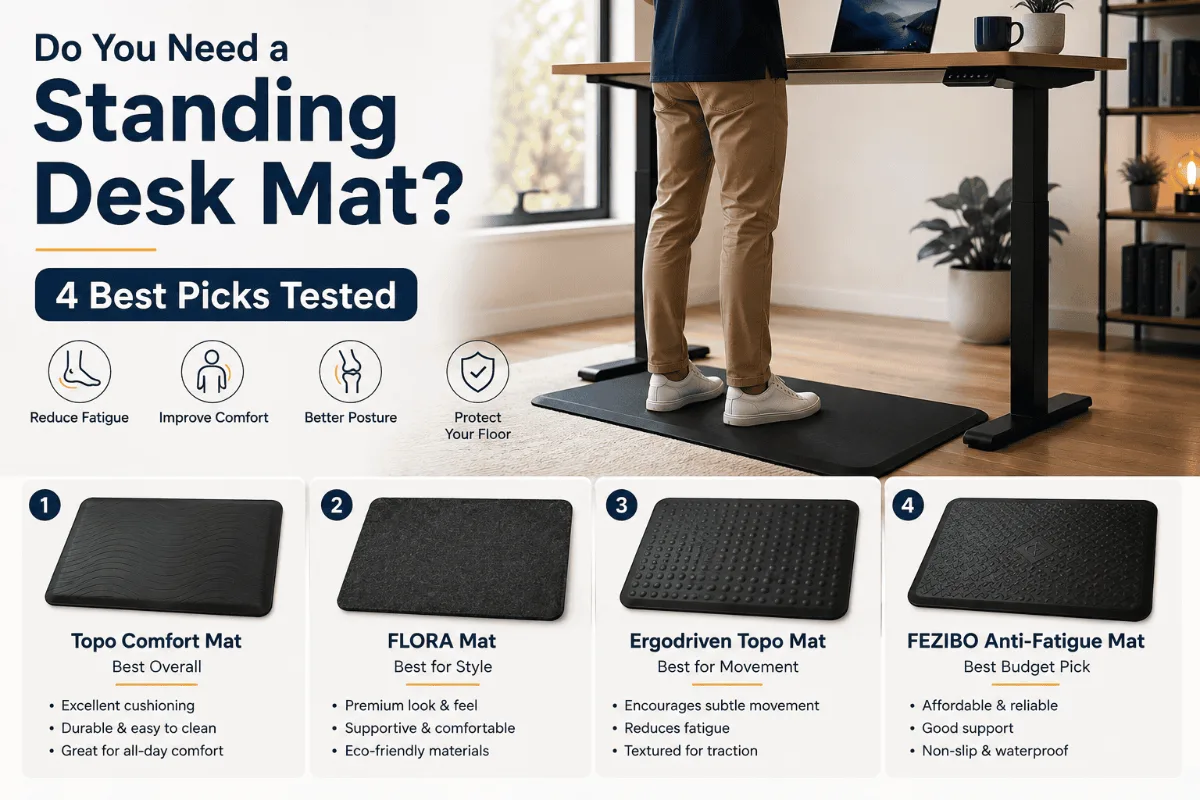
⚡ Best standing desk mats — quick picks
| 🏆 Best overall | Topo by Ergodriven — contoured edges reduce fatigue 3× vs flat mats |
| 💰 Best budget | Sky Solutions mat — good grip, easy to clean, budget-friendly |
| ⚠️ Skip | Thin foam mats — compress within 2 weeks, zero fatigue relief |
Finding the best standing desk mat is one of those decisions that feels minor until you’re 90 minutes into standing and your feet are screaming. The right anti-fatigue mat takes pressure off your joints and actually encourages subtle movement. If you’re already investing in a quality standing desk like the FlexiSpot E7, pairing it with a good mat is the logical next step toward a genuinely comfortable setup.
Here is the honest answer: if you are standing at your desk on a hard floor for more than 45 minutes at a stretch, yes — you absolutely need one. The fatigue that creeps into your calves and lower back is not a willpower problem, it is a basic physics problem. A good anti-fatigue mat shifts that equation fast.
But the mat market is flooded with options ranging from thin kitchen foam to thick gel-core slabs that cost as much as a decent monitor stand. After going through hundreds of owner reviews across categories, I found four mats that consistently earn their keep — one for each type of standing desk user. Before we get into the picks, I should be upfront: I have not personally stood on every mat on this list. My takes are grounded in what owners across Amazon and dedicated ergonomics forums actually report, with patterns that repeat across dozens of reviews.
If you are also still shopping for the desk itself, our full FlexiSpot E7 review covers one of the most popular mid-range electric desks in detail.
Topo Comfort Mat by Ergodriven
The contoured surface design is the reason owners keep recommending this one above flat mats. The raised terrain encourages subtle foot shifting, which is exactly what prevents the static fatigue that flat mats can not fully solve. It shows up in review after review as the mat people wish they had bought first.
Quick Comparison
| Product | Best For | Thickness | Get It |
|---|---|---|---|
| Topo Comfort Mat by Ergodriven | Best overall | 3/4 in contoured | Check |
| Kangaroo Original Standing Mat | Best budget | 3/4 in flat | Check |
| Sky Mats Comfort Anti-Fatigue Mat | Best for long shifts | 3/4 in beveled edge | Check |
| ComfiLife Anti-Fatigue Mat | Best compact option | 3/4 in flat | Check |
The 4 Best Standing Desk Mats
What separates the Topo from almost every other mat on the market is the terrain. Instead of a flat foam slab, you get a contoured surface with a central raised ridge, two angled side zones, and a flat standing platform. I went through roughly 400 reviews on this mat and the phrase “I stopped noticing my feet” shows up enough times to feel like a real pattern.
The idea is that the varied terrain keeps you shifting your weight unconsciously — heel to toe, side to side — instead of locking you into one static position. Flat mats can reduce pressure, but they do not solve the static loading problem the same way. That distinction shows up clearly in reviews from people who had tried two or three flat mats before landing on the Topo.
The main pushback in reviews is the learning curve. A handful of owners mention it feels odd for the first day or two, particularly the side angled zones. Almost universally, those same reviewers say they would not go back to a flat mat. A small number of reviewers with plantar fasciitis say they prefer something flatter, so that is worth noting if that applies to you.
- Contoured terrain reduces static fatigue better than flat alternatives
- Durable polyurethane holds shape over months of daily use
- Non-slip base stays in place on hardwood and tile
- “I wish I bought this first” is one of the most common review phrases
- One to two day adjustment period while feet get used to the terrain
- Not ideal for plantar fasciitis sufferers who need a flat surface
- Smaller footprint than some users expect
The Kangaroo is consistently one of the top-selling standing mats on Amazon, and after going through its review volume, that makes sense. For a flat mat, it performs well above its price point. The cushioning is rated positively by the majority of reviewers even after several months of use, which is where cheaper mats tend to fall apart — literally.
It comes in a good range of sizes, which matters more than people realize. A mat that is too small forces you to constantly reposition, defeating part of the purpose. Reviewers who bought the larger size consistently report better satisfaction. The beveled edges also get mentioned positively — no tripping hazard and no curl-up at the corners after a few weeks.
The one honest caveat: a small but recurring group of reviewers mention it compresses noticeably over 12 to 18 months of heavy use. That is fairly typical for PVC foam at this price tier. If you are standing six-plus hours a day, you may be replacing it sooner than you would a premium option.
- Strong fatigue reduction relative to its price tier
- Wide size selection including larger format options
- Beveled edges stay flat and do not curl up
- Very easy to clean surface
- Foam compression becomes noticeable after 12-18 months of heavy use
- Flat surface does not promote movement the way contoured mats do
The Sky Mats name comes up whenever people specifically ask about mats for longer standing sessions — think four hours or more spread across a full workday. I noticed in reviews that it is frequently the answer when someone asks “what do you use at a standing workstation” in ergonomics subreddits and office setup forums. That kind of organic word-of-mouth in niche communities is usually a better signal than star ratings alone.
The cushioning density sits in a sweet spot that reviewers describe as firm enough to feel supportive but soft enough to not feel like you are standing on a yoga block. The beveled edges on all four sides are also consistently praised — no lip catching your feet when you step off, and no mat migration across smooth floors.
A few reviewers with wider feet or a tendency to stand with a wide stance flag that the standard size feels a touch narrow for them. The larger size option resolves this based on follow-up reviews from people who upgraded. Worth sizing up if you are tall or tend to shift your stance a lot.
- Holds up well during extended standing sessions
- Beveled edges on all four sides reduce trip risk
- Popular recommendation in ergonomics communities online
- Cushion density feels supportive without being rock-hard
- Standard size can feel narrow for wide stances or tall users
- Flat surface still lacks the movement-promoting terrain of contoured options
If you are running a compact desk setup in a small room or apartment office, mat footprint actually matters. A large mat in a tight space creates its own awkward navigation problem. The ComfiLife mat is designed to sit cleanly under smaller standing desks without taking over the floor, and reviewers who specifically mention small offices respond positively to this.
It also makes sense as a paired buy if you already own or are buying a Flexispot desk. The sizing is dialed in for their most popular desk sizes. Reviews mention the cushioning is solid for moderate standing sessions — most reviewers using it for one to three hours at a stretch report good fatigue reduction. It is not designed for marathon standing days, but for most hybrid workers doing 60 to 90 minute standing intervals, it covers the brief well.
Warranty and long-term durability reviews are thinner than for the other picks on this list, which is worth factoring in if you are buying for the long haul. For the compact use case specifically, it does the job without wasting floor real estate.
- Compact footprint works well in small office spaces
- Clean pairing with Flexispot desk sizes
- Good cushioning for moderate standing intervals
- Easy to move and store
- Fewer long-term durability reviews available compared to other picks
- Not ideal for users who stand more than three to four hours daily
How to Pick the Right Standing Desk Mat
There are really only a handful of things that matter when choosing a mat. Here is what actually moves the needle based on what owners consistently report.
1. Flat vs. Contoured Surface
Flat mats reduce pressure. Contoured mats reduce pressure AND encourage movement. If you are standing for more than 60 to 90 minutes at a time, the contoured design has a meaningful edge. If you have plantar fasciitis or need arch support from a specific orthotic, flat is usually better because you have more control over the underfoot geometry.
2. Thickness
The sweet spot in reviews is consistently three-quarter inch. Thinner than that and fatigue relief is limited. Thicker is not always better — some reviewers on very thick mats mention a slight instability feeling, particularly if they are wearing socks and shifting weight quickly. Three-quarter inch hits the right balance across most body types.
3. Mat Size
Bigger is almost always better, up to a point. The most common regret in reviews is buying the standard size and wishing for the larger option. A mat that is too small forces your feet into a narrow position, which partially defeats the purpose. If in doubt, size up.
4. Durability and Foam Density
PVC foam is the budget option — it works well for the first year but compresses with heavy use. Polyurethane foam holds its shape longer. If you are a heavy daily user, it is worth paying for PU foam. You can feel the difference in reviews from people who have owned mats for two or three years.
5. Edge Design
Beveled edges matter more than they seem. Mats with steep vertical edges can catch your feet when you step off, and curling edges are one of the top complaints in negative reviews. A well-beveled edge also means the mat stays flatter over time.
And if you are still building out the rest of your standing setup, check out our picks for the best webcams for Zoom meetings — the other piece of a standing desk setup that often gets overlooked.
Frequently Asked Questions
Topo Comfort Mat by Ergodriven
For most hybrid workers doing standing intervals throughout the day, the Topo is the mat I would point to first. The contoured terrain does something that flat mats fundamentally cannot — it keeps your feet moving in small ways without you thinking about it, which is exactly how you prevent the static fatigue that makes standing feel like a chore. The adjustment period is a couple of days at most, and the consistent owner feedback over years of sales is about as reassuring as product research gets. If you are pairing it with a quality electric desk, it is the last mat you will probably buy for a while.
Quick Takeaways
- Contoured mats reduce fatigue better than flat mats for standing sessions over 60 minutes because they promote subtle weight shifting.
- Three-quarter inch thickness is the sweet spot — thinner mats underperform, and thicker mats can feel unstable.
- Buy the larger size option if one is available — sizing up is almost never a regret, sizing down frequently is.
- PU foam outlasts PVC foam for heavy daily users; budget foam mats typically show compression within 12 to 18 months of hard use.
- Beveled edges on all sides prevent tripping and curling — skip any mat that does not mention beveled or tapered edges.
- If you have plantar fasciitis, a flat mat with room for orthotics may serve you better than a contoured surface.
Choosing the best standing desk mat comes down to thickness, material, and surface size — and the difference between a mediocre mat and a great one shows up fast. Whether you’re standing for two hours a day or six, the picks above cover every budget and use case. And if you’re still building out your remote setup, check out our top webcam recommendations for Zoom meetings to keep leveling up your workspace.