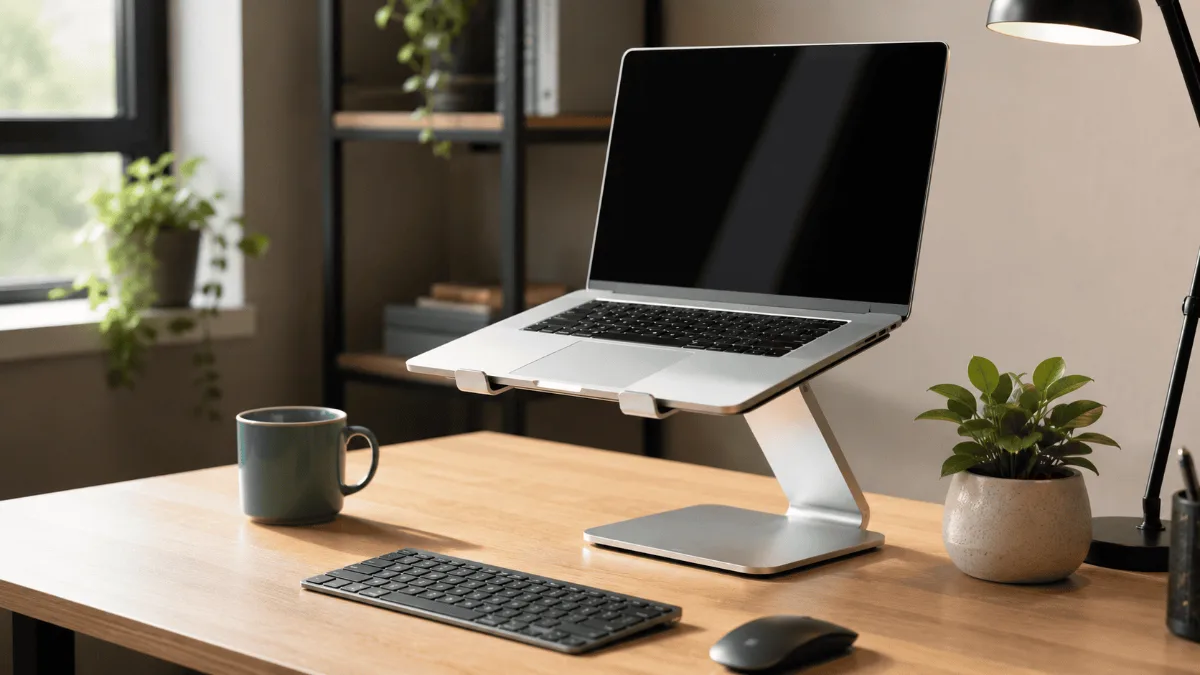
The best laptop stand for dual monitors needs to do more than just raise your screen — it has to coexist with two external monitors without eating your whole workspace. Finding the best laptop stand for dual monitor setup is harder than it sounds. Most stands are built for solo-laptop desks, not the cramped real estate of a two-monitor rig. This guide cuts through the noise and focuses on stands that actually play well with a dual-monitor workflow — stable, compact, and properly adjustable. If you already have the best laptop stand for dual monitor setup sorted, the next thing to nail is your peripherals. A good stand solves the height problem, but cable management, monitor arms, and docking stations determine whether your desk stays functional or turns into a mess. Check out our picks for the best webcams for Zoom meetings once your ergonomics are dialed in.
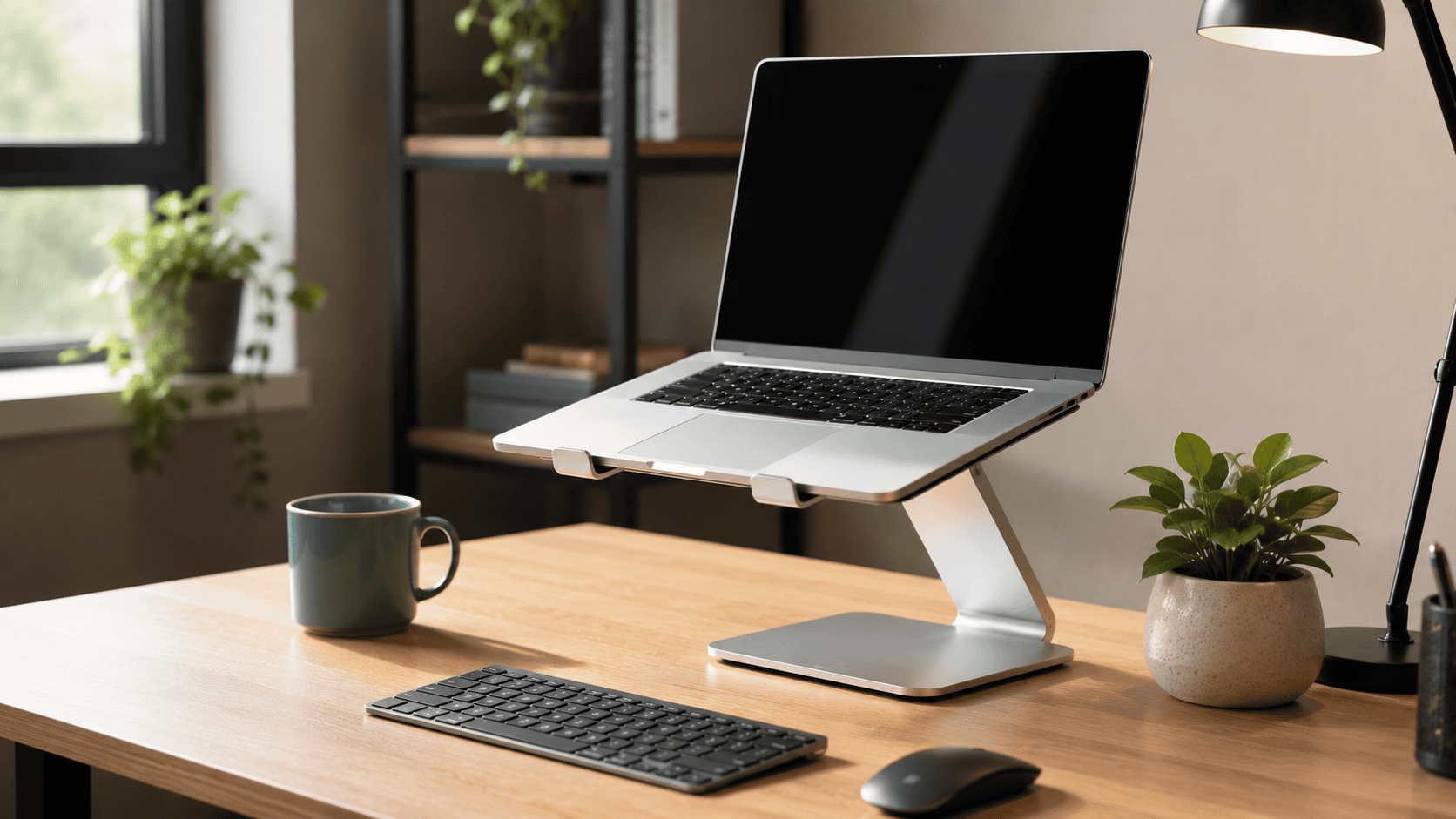
Here is the problem with most laptop stand roundups: they treat the laptop as the only screen on the desk. But if you are running a dual-monitor setup, the laptop is a third screen, and suddenly every centimeter of desk depth and every inch of height adjustment matters twice as much.
Nulaxy C1 Laptop Stand
The laptop stand that pairs best with a dual-monitor desk setup — raises the screen to eye level to match your external monitors, folds flat when you disconnect, and owners consistently report it stays stable even with larger 15″ and 16″ laptops.
Check Price on Amazon →A stand that works great on a solo laptop desk can completely block airflow from a monitor arm base, sit too low to match your external screens, or just take up so much real estate that your keyboard has nowhere to go. I went through hundreds of owner reviews specifically filtering for people using stands alongside two external monitors, and the complaints are pretty consistent across bad picks.
The five stands below survived that filter. They are compact enough to coexist with dual-monitor gear, stable enough not to wobble when you tap the trackpad, and adjustable enough to get your laptop screen into a sensible position. Here is what I found.
Nulaxy C1 Laptop Stand
Solid aluminum, six angle settings, genuinely stable on a crowded desk, and compact enough to leave room for everything else in a dual-monitor rig. Owners consistently call it the most stable stand at this tier.
See Current Price →Best laptop stand dual monitor: Quick Comparison
| Product | Best For | Build | Get It |
|---|---|---|---|
| Nulaxy C1 | Best overall | Aluminum, 6 angles | Check |
| VIVO Dual Monitor Arm | Best for freeing desk space | Steel arm, 13–27in | Check |
| Anker 577 USB-C Dock | Best stand + hub combo | 13 ports, 85W PD | Check |
| YSAGi Leather Desk Pad | Best desk foundation | PU leather, non-slip | Check |
| FlexiSpot E6 MAX | Best if the whole desk needs an upgrade | Dual motor, 275lb cap | Check |
The Full Breakdown
The Nulaxy C1 is the stand that keeps coming up when people specifically ask about dual-monitor setups. It is narrow enough that it does not eat into the footprint you need for your keyboard and mouse, and the six angle settings give you enough range to line up the laptop screen reasonably close to your external monitor heights.
Across the reviews I went through, stability is the word owners use most. The rubber feet grip the desk without sliding around when you tap the keyboard or adjust the screen. A few owners note the lack of ventilation holes in the base platform, but most report no meaningful heat buildup in normal use — worth watching if your laptop runs hot under load.
It folds flat for travel, which is a nice bonus for hybrid workers who split time between home and office. The build quality reads as premium for what you pay, with owners frequently mentioning it feels solid compared to plastic alternatives at similar or higher price points.
- Solid aluminum feels genuinely premium
- Six angle settings cover most ergonomic needs
- Compact footprint plays well on crowded dual-monitor desks
- Folds flat for bag-friendly portability
- Rubber feet hold firm without scratching desks
- No ventilation holes — could be a concern for hot-running laptops
- Angle increments are fixed, not infinitely adjustable
Strictly speaking, this is a monitor arm and not a laptop stand — but hear me out. The number one reason laptop stands feel cramped on a dual-monitor desk is that the monitor stands are eating your desk depth. Mount both external monitors on this arm and you suddenly have the surface space to use any laptop stand comfortably.
The VIVO arm handles monitors from 13 to 27 inches, mounts via C-clamp or grommet, and owners consistently describe the initial stiffness as something that loosens up after the first few adjustments. It is not the most elegant-looking arm out there, but reviews cluster around solid build quality and reliable hold once dialed in.
If your current desk situation is genuinely cramped, adding a monitor arm alongside the Nulaxy C1 above is the combination that keeps surfacing in dual-monitor setup threads as the most effective desk-clearing move.
- Clears significant desk depth by lifting monitors off their stands
- Fits most common monitor sizes up to 27in
- Dual mount options (C-clamp and grommet) for different desk types
- Solid steel build holds position once adjusted
- Stiff out of the box — takes some break-in time to adjust smoothly
- Basic aesthetic, not the sleekest arm on the market
A laptop stand without the right dock in a dual-monitor setup is only half the solution. Your laptop is elevated, great — but now you need one cable to connect both monitors, your keyboard, mouse, ethernet, and charge the machine simultaneously. That is exactly what the Anker 577 is built for.
Dual 4K HDMI outputs mean both external monitors get full resolution signal. The 85W power delivery keeps your laptop charged through the same single USB-C connection. Owners flag that it runs warm under heavy load, but I could not find reports of throttling or shutdowns in normal office use — the heat seems to be cosmetic rather than functional.
No Thunderbolt support is the main caveat. If you need Thunderbolt bandwidth for something specific, this is not your dock. For the majority of dual-monitor remote workers running video calls, documents, and browser tabs, the 577 covers everything without requiring a Thunderbolt machine.
- 13 ports covers nearly every peripheral scenario
- Dual 4K HDMI — both monitors get full resolution
- 85W PD charges most laptops while docked
- Single-cable connection to the laptop keeps desk tidy
- No Thunderbolt — limits bandwidth ceiling
- Runs warm under sustained heavy load
This one might seem like a stretch for a laptop stand article, but stay with me. When you put a laptop stand, a dock, a keyboard, a mouse, and two monitor bases on a desk, things start sliding. A non-slip desk pad underneath everything stops that creep and makes the whole setup feel intentional instead of thrown together.
The YSAGi’s non-slip base keeps the laptop stand from drifting when you tap the keyboard. The waterproof PU surface means spilled coffee does not ruin your desk. Owners consistently rate it well on both counts. The two-sided design (dark and light) is a minor bonus for people who like to switch things up.
The main complaint is corner curling over time, which several long-term owners mention. A few suggest using small weights on the corners for the first week to train it flat. It is thin, so do not expect serious cushioning — this is purely about surface protection and stability.
- Non-slip base keeps everything anchored on a busy dual-monitor desk
- Waterproof PU surface handles accidental spills
- Reversible two-color design
- Available in multiple sizes and colors
- Corners can curl — most owners resolve it with short break-in period
- Thin construction, minimal cushioning
Sometimes the real issue is not the laptop stand — it is that your current desk is too shallow, too narrow, or just the wrong height for a dual-monitor rig. If that is where you are, a standing desk is a more fundamental fix, and the FlexiSpot E6 MAX is the one that keeps coming up as the best-value dual-motor option.
The 275-pound weight capacity handles two monitors, a laptop stand, a dock, and whatever else you pile on without complaint. Four programmable height presets mean you can switch between sitting and standing without hunting for the right position. Anti-collision detection — which stops the desk if it senses an obstacle during height adjustment — is something owners in apartments with low shelving cite as a genuine relief.
Assembly runs 30 to 45 minutes based on what reviews report, and the 72-pound frame weight means this is a two-person job. Read our full FlexiSpot E6 MAX review for a deeper look at how it holds up over time. But if your dual-monitor setup is being held back by the desk itself, this is the upgrade worth making.
- Dual motor handles a full dual-monitor load without wobble
- 275lb capacity is one of the highest at this price tier
- Anti-collision detection is a practical safety feature
- Four memory presets make sit-stand switching effortless
- Assembly takes 30–45 minutes and really needs two people
- 72-pound frame is not easy to move once assembled
How to Pick the Right Stand for a Dual-Monitor Setup
Most buying guides talk about laptop stands in isolation. Here is how to think about the choice when two external monitors are in the picture.
1. Footprint first
Measure your available desk depth before buying any stand. A dual-monitor desk often has a monitor arm base, a keyboard, a dock, and sometimes speakers competing for surface space. A stand that is even two inches too deep can force your keyboard off the edge.
2. Height range versus your monitor height
Your laptop screen does not need to match your external monitors exactly — but if the height difference is extreme, you will be constantly tilting your neck. Look for stands with at least four or five angle settings so you have room to dial it in. The Nulaxy C1’s six settings give you decent range for this.
3. Stability under keyboard-tap load
This sounds minor until it is not. On a laptop stand, every keystroke on the built-in keyboard (if you still use it) transfers vibration to the stand. Lightweight plastic stands on smooth desks drift or rattle. Aluminum construction plus rubber feet — like the Nulaxy C1 — is the combination that keeps showing up in positive reviews from dual-monitor users.
4. Think ecosystem, not just stand
The stand is one piece. A good webcam for your video calls, a monitor arm to free up desk depth, and a dock to handle all your cables — these things work together. Buying just the stand and ignoring cable chaos is a half-solution.
5. Portability if you go hybrid
If you commute to an office a few days a week, a foldable aluminum stand that fits in a laptop bag changes the value calculation significantly. A stand that lives permanently on your home desk can be heavier and sturdier. A stand you carry should fold flat and weigh under a pound.
Nulaxy C1 Laptop Stand
For a dual-monitor setup, the Nulaxy C1 is the stand that consistently earns praise from people who have actually tried to fit it into a crowded desk. It is aluminum without being oversized, stable without being heavy, and adjustable enough to get your laptop screen into a sensible position relative to your external monitors. If you want to go further, pair it with the VIVO monitor arm to free up desk depth and the Anker 577 dock to cut the cable clutter down to a single connection. That combination is as close to a fully dialed dual-monitor setup as you can get without redesigning the whole desk.
Get the Nulaxy C1 on AmazonQuick Takeaways
- The Nulaxy C1 is the best standalone laptop stand for a dual-monitor desk — compact, aluminum, stable, and adjustable across six angles.
- A dual monitor arm (VIVO) is the single best move for reclaiming desk space in a cramped setup, making any laptop stand work better.
- A docking station (Anker 577) is the connectivity half of the solution — your stand elevates the laptop, the dock handles all the cables in one plug.
- A desk pad (YSAGi) is underrated: it stops everything from drifting and makes the whole setup feel cohesive.
- If the desk itself is the bottleneck — too narrow, too shallow, wrong height — the FlexiSpot E6 MAX is the upgrade that fixes the root problem.
- Measure your desk depth before buying a stand. Two monitors, a keyboard, and a stand have to fit without pushing anything off the edge.
- Heat concerns on stands are mostly about vent coverage, not elevation — stands that hold the laptop by the edges are better for hot-running machines than solid-tray designs.