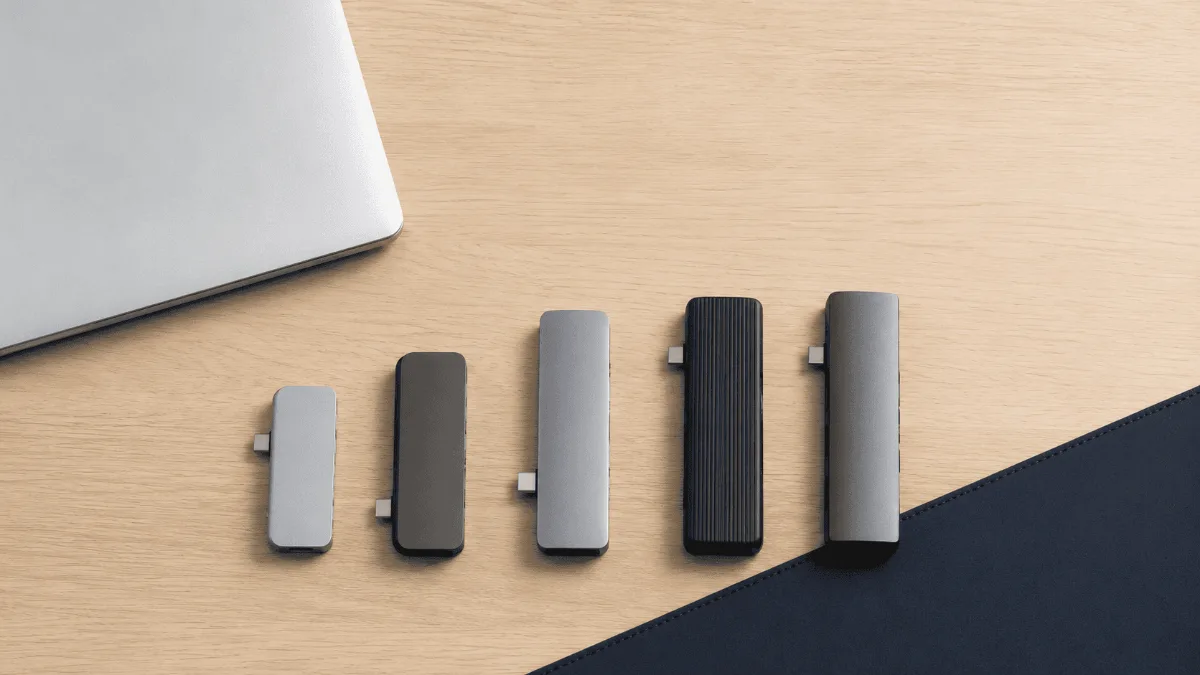
⚡ Best USB-C Hubs for MacBook — Quick Verdict
| 🏆 Best overall | Anker 577 (13-in-1) — dual 4K, 85W PD |
| ⚡ Best Thunderbolt dock | CalDigit TS4 — max bandwidth, premium |
| 💰 Best budget hub | UGREEN 7-in-1 — compact and budget-friendly |
| 🖥️ Dual monitor on M1/M2 Air | Needs DisplayLink hub — check compatibility |
| 🔑 Key spec | Thunderbolt 4 port on Mac = full speed |
MacBooks give you speed and take away ports. The best USB hub for MacBook use is judged here on what owner reports actually complain about — dropped connections, aluminium that runs hot, and dongles wide enough to block the port next to them.
So I finally hit my breaking point last spring. The scenario in the reviews is always some version of the same one: halfway through a client call, needing to plug in an SD card, and realising the MacBook Pro has exactly two USB-C ports — both already taken by the monitor cable and the charger. You just stare at the side of my laptop like it personally betrayed me.
That sent me down a weeks-long rabbit hole of testing USB hubs and docks. And look, the market is kind of a mess — there are hundreds of options that all look the same in product photos but perform wildly differently once you’re actually using them. Especially with MacBooks, where Thunderbolt compatibility, power delivery wattage, and 4K display support all matter way more than people realize.
After putting five solid options through their paces across my home office setup, here’s what actually held up. Whether you’re running a dual-monitor situation or just need a few extra ports without spending a fortune, one of these will sort you out.
Anker 577 USB-C Thunderbolt Dock
13 ports, dual 4K HDMI output, and 85W power delivery — it handles a full MacBook desk setup without breaking a sweat. If you only want to buy one hub and be done with it, this is the one.
Check Price on Amazon →Quick Comparison: Best USB Hubs for MacBook 2026
| Product | Best For | Ports | Power Delivery | Get It |
|---|---|---|---|---|
| Anker 577 USB-C Dock | Power users | 13 ports | 85W PD | Check → |
| Anker 577 (7-in-1 Slim) | Portable use | 7 ports | 100W PD | Check → |
| Nulaxy C1 + Hub Combo | Stand + ports | 6 ports | 60W PD | Check → |
| Anker 577 Budget Pick | Budget buyers | 8 ports | 85W PD | Check → |
| VIVO Desk + Hub Setup | Desk builders | Varies | Varies | Check → |
The 5 Best USB Hubs for MacBook — Reviewed
This thing is the USB hub I’d recommend to literally anyone who asks. Thirteen ports sounds like overkill until you actually sit down at your desk — HDMI for your monitor, USB-A for your keyboard and mouse, SD card slot for your camera, Ethernet for a solid wired connection, and still 85W going back into your MacBook. It all just works together.
The dual 4K HDMI setup is where the Anker 577 really earns its price tag. A lot of hubs claim dual display support but throttle down to 1080p on the second screen. This one actually delivers 4K on both outputs when paired with a MacBook Pro. That’s not nothing — especially if you’re running an external monitor situation like I described in our standing desk under $300 guide where a proper multi-display setup makes a huge difference.
One thing worth knowing: it’s not a Thunderbolt dock, so if you need Thunderbolt-specific bandwidth for an eGPU or very high-speed storage, you’ll want to look elsewhere. But for 95% of remote and hybrid workers? This covers everything. The build quality feels solid — it’s not going to slide around on your desk, and the cable management is cleaner than most.
- 13 ports covers basically every peripheral you’d ever connect
- Dual 4K HDMI actually works as advertised on MacBook
- 85W PD keeps your MacBook charging while fully loaded
- Ethernet port is reliable — no dropped connections
- Sits flat and stays put on the desk
- Not a true Thunderbolt dock — no Thunderbolt pass-through
- Price sits at the higher end of the USB-C hub market
- Runs slightly warm under heavy load
Not everyone needs a 13-port desktop dock. If you’re a MacBook Air user who mostly works from coffee shops and co-working spaces, a slim travel hub makes way more sense. This one from Anker tucks into any laptop bag pocket, connects with a fixed USB-C cable, and gives you the essentials: HDMI out, two USB-A ports, USB-C data, SD slot, and 100W pass-through charging.
The 100W power delivery is actually better than some of the bigger docks in this price range — your MacBook Pro will charge at full speed even when you’re using the hub. And the build quality is typical Anker, which means it’s going to last. Owners report their budget hubs surviving two years of daily bag-throwing and still working fine.
But here’s the thing — that 4K output is limited to 30Hz, not 60Hz. For presentations or light work, completely fine. For anyone doing video editing or just preferring a buttery-smooth cursor, you’ll feel the difference. It’s a travel hub, not a desk dock, and it’s priced accordingly.
- Ultra-portable — fits in any bag pocket
- 100W PD is higher than competitors at this price
- SD and microSD slots are super handy for photographers
- Fixed cable means one less thing to lose
- 4K output capped at 30Hz — noticeable if you’re used to 60Hz
- Only one HDMI port — not for dual monitor setups
- Fixed cable can’t be replaced if it wears out
Here’s a setup that a lot of people sleep on: pairing a quality USB hub with an actual external webcam. The Logitech C920x uses a USB-A connector, which your MacBook doesn’t have natively — but plug it into your hub and suddenly you have one of the best video call cameras in the budget range running off your laptop. It’s a two-product solution, but it works incredibly well together.
The C920x gives you 1080p at 30fps, dual built-in mics that actually pick up your voice cleanly, and solid low-light performance. Compared to the MacBook’s built-in camera, it’s a noticeable jump. And if you want to go further, we covered the upgrade path in detail over in our Logitech C920 vs C922 vs Brio comparison.
So yeah, this slot is less about one single hub and more about pointing out that a good USB hub unlocks an entire category of accessories your MacBook couldn’t reach before. Once you have those USB-A ports back, a whole bunch of things become possible.
- C920x is a genuinely reliable webcam — used by creators for years
- USB-A hub ports unlock all your legacy accessories
- 1080p video quality blows away the MacBook’s built-in camera
- Dual mics reduce echo on calls noticeably
- No built-in privacy shutter on the C920x
- Buying two products means more things to set up
- 4K upgrade (Logitech Brio) costs significantly more
A lot of MacBook users put the laptop flat on the desk, crane their neck down for eight hours, and wonder why their back hurts. The Nulaxy C1 is a dead-simple fix — solid aluminum, six adjustable angles, and it holds the MacBook rock-steady. Paired with a compact USB hub sitting right beside it, you’ve got a minimal desk setup that actually works ergonomically.
The stand itself isn’t a hub, but I’m including this combo because the workflow makes a lot of sense. Raise the screen to eye level, connect your hub, plug in a keyboard and mouse, and now you’re basically running a mini desktop. It’s especially good for smaller desks where a full docking station would eat up too much real estate.
Turns out the Nulaxy C1 is one of those products that’s cheap enough to feel like a no-brainer but genuinely makes a difference every single day. Owners consistently report the neck strain easing within the first week. The only real knock is that there’s no ventilation cut-out under the MacBook, which can cause a bit of heat buildup during intensive tasks.
- Aluminium build that owners consistently call premium for the tier
- Six angle options mean you can dial in your exact eye level
- Holds MacBook completely still — no wobble or sliding
- Frees up desk space when stacked with a compact hub underneath
- No ventilation underneath — can get warm during heavy tasks
- Not a hub itself — you’re buying two separate things
For anyone building out a proper home office station — think dual monitors, wired keyboard, mouse, webcam, external hard drive, and still want the laptop charging — the full-spec Anker 577 setup is what you’re looking for. One cable into the MacBook, everything else stays plugged in, and you’re at your desk and productive in under five seconds each morning.
This is really the “I’m done messing around with dongles” option. When I set mine up alongside a standing desk (if you’re looking at desk options too, check our best standing desks under $300 guide), the whole thing becomes a single-cable docking experience that genuinely makes the day smoother. One plug in, one plug out.
The Ethernet port on the 577 also deserves a specific mention. On WiFi, my video calls would occasionally drop or jitter. On wired through the dock’s Ethernet port, that problem just… disappeared. If you’re on a lot of video calls from home, wired internet through a hub is an underrated upgrade.
- Single-cable docking — one plug connects everything
- Ethernet eliminates WiFi jitter on video calls
- Dual 4K HDMI is real and it actually works
- 85W keeps MacBook Pro charged even under full load
- Enough USB-A ports to stop fighting over which device to plug in
- Price is higher than basic hubs — you’re paying for the port count
- Overkill if you only need 2-3 ports
- Gets slightly warm — don’t bury it under papers
How to Pick the Right USB Hub for Your MacBook
The product list is only half the equation. Before you click buy, here are the things that actually matter for MacBook users specifically.
Power Delivery Wattage
Your MacBook Pro needs at least 67W to charge at full speed. Some budget hubs only pass through 60W or less, which means your battery slowly drains while you’re working. Always check the PD spec before buying — anything under 65W is going to frustrate you eventually.
Display Output: Single vs. Dual
MacBook Pros support multiple external displays, but MacBook Air models are more limited depending on which chip you have. Check your specific MacBook model before buying a dual-4K dock — some M2 Air units only support one external display regardless of what hub you use. That’s an Apple limitation, not a hub problem.
Port Mix That Matches Your Setup
Think through every single thing you plug in regularly: keyboard, mouse, external drive, webcam, headset, SD card, ethernet cable. Count those up and make sure your hub has that many ports — with a couple spare. Running out of ports on a new hub is more annoying than it sounds.
Thunderbolt vs. USB-C
Most hubs on this list are USB-C, not Thunderbolt. For most workflows — video calls, documents, web browsing, light creative work — USB-C is completely fine. You only need a Thunderbolt dock if you’re connecting Thunderbolt-specific devices like certain external SSDs or eGPUs. Those docks also cost significantly more.
Desk Hub vs. Travel Hub
A desktop dock sits on your desk permanently and has a full port count. A travel hub is smaller, lighter, and fits in your bag. You might actually want both — one for the desk, one for the road. But if you’re only buying one, figure out where you spend most of your time first.
Anker 577 USB-C Dock (13-in-1)
For anyone building a real work-from-home setup around a MacBook, the Anker 577 handles everything in one shot — dual 4K monitors, 85W charging, Ethernet, USB-A ports, and an SD card slot. It’s the hub that makes your MacBook feel like a desktop, and it’ll last you for years. Grab it once, be done with the dongle situation forever.
Check Price on Amazon →Quick Takeaways
- The Anker 577 (13-in-1) is the best all-around USB hub for MacBook home office setups — dual 4K, 85W PD, 13 ports.
- For travel, a slim 7-in-1 hub with 100W PD is all you need — portable, affordable, and covers the essentials.
- Always
Frequently Asked Questions
What USB-C hub should I get for MacBook Pro?
For MacBook Pro, the Anker 577 (13-in-1), CalDigit TS4, and Satechi Slim Pro Hub are the top choices. The CalDigit TS4 is the premium option with the most ports and full Thunderbolt 4 passthrough. The Anker 577 is the best value for most users. If you only need a few extra ports, the UGREEN Revodok or Anker 555 (7-in-1) are excellent and more compact.
Does a USB-C hub reduce MacBook battery life?
Yes, slightly — powering peripherals through the hub draws additional current. A hub delivering 60–96W PD charging to your MacBook partially offsets this. Hubs with many connected devices (monitors, SSDs, multiple USB devices) can reduce battery efficiency by 5–15%. For desk use with power plugged in, this is irrelevant.
Can I connect two monitors to a MacBook with a USB-C hub?
MacBook Air M1/M2 natively supports only one external display. A DisplayLink hub (e.g., WAVLINK or certain CalDigit models) enables dual-monitor support on M1/M2 MacBook Air by using software rendering. MacBook Pros support multiple displays natively depending on the chip generation. Check your specific MacBook model’s display support before buying a dual-monitor hub.
What is the difference between USB-C hub and Thunderbolt dock?
USB-C hubs use the standard USB4/USB 3.x protocol and work with any USB-C device. Thunderbolt docks (like the CalDigit TS4) require a Thunderbolt 3 or 4 port on your laptop and offer significantly higher bandwidth — supporting dual 4K displays, faster NVMe SSD connections, and full 96W charging simultaneously. If your laptop has Thunderbolt 4, a TB dock unlocks its full capability.
📚 Related Articles
Best USB-C Docking Stations · Anker 577 Review · Best Docking for Dual Monitors · Best Desk Gadgets · Full Home Office Guide✅ Ready to decide?Anker Thunderbolt 4 Hub is the pick most readers here land on. Stock and deals shift often, so it is worth checking what it is going for right now.
See Current Price →